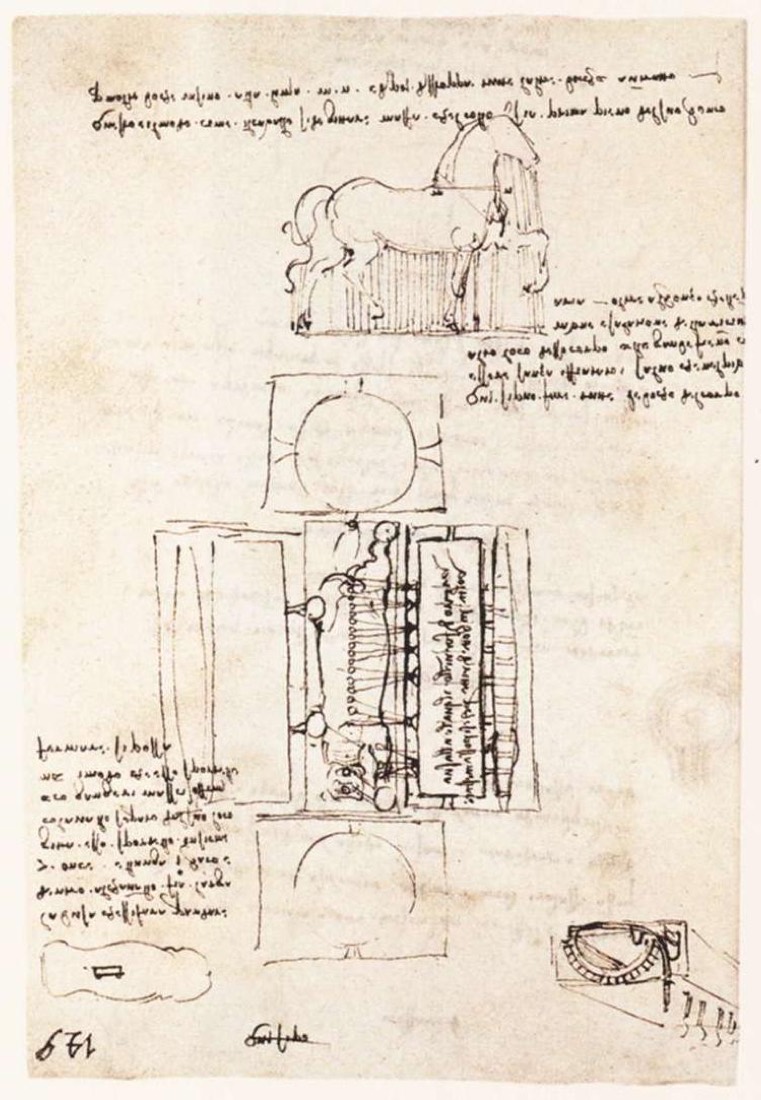
Della proporzione
Italiano
Prima della pittura — prima delle macchine, prima dell'acqua, prima del cuore — vi è la proporzione.
Non lo dico come un maestro lo direbbe a un allievo. Lo dico come uomo che ha passato quarant'anni scoprendo che ogni cosa che ha compreso, l'ha compresa perché aveva prima compreso il rapporto.
Il volto: l'occhio sta al punto medio tra la corona e il mento. La mano: dal polso alla punta del dito è la stessa misura che dal gomito al polso, divisa pel medesimo rapporto. Il cavallo: la gamba dallo zoccolo al ginocchio è un terzo della gamba intera. Il fiume: la pendenza che un uomo dà a un canale deve corrispondere alla pendenza che il fiume stesso vuole, o l'acqua si ribella.
Queste non sono regole che ho imposto. Sono regole che ho trovato. Vi è differenza.
Vitruvio insegnò che un uomo, a braccia tese, sta dentro un cerchio il cui centro è il suo ombelico. Sta anche dentro un quadrato. L'ho disegnato. L'ho disegnato molte volte. Ciò che non scrissi, quando feci il disegno, fu che il combaciare mi sorprese. Mi aspettavo di dover correggere. Non dovetti correggere. Il corpo era semplicemente ciò che Vitruvio diceva fosse, e la sorpresa non era nella scoperta ma nell'accordo — che il mondo si fosse curato d'esser regolare alla scala d'un uomo.
Questo è il punto in cui non so cosa pensare.
Se la proporzione è ovunque — nel girarsi della foglia, nelle camere del cuore, nei fiumi e nei canali e nelle membra dei cavalli — allora o il mondo è fatto (e il fattore ha particolare amore per i rapporti, cosa che i preti direbbero, e che non posso escludere), o la proporzione è la sola sorta d'arrangiamento che regge (e ciò che non regge è ciò che mai vediamo, perché è già crollato).
Non posso decidere tra le due. Noto che la seconda inghiotte la prima — se la proporzione è la sola che regge, allora un fattore avrebbe dovuto sceglier la proporzione perché regge, e siamo di nuovo al mondo che sceglie.
Ma anche la prima inghiotte la seconda, in altra direzione. Se un fattore scelse, la domanda solo si sposta: cosa nella proporzione attrasse lo scegliere? E siamo di nuovo al mondo che era in un certo modo prima d'ogni scelta.
Questi pensieri mi danno mal di capo. Li scrivo comunque.
Ciò di cui son certo:
— Che ogni disegno comincia in misura. — Che ogni macchina comincia in misura. — Che ogni corpo, aperto, rivela misura. — Che l'occhio, non istruito, trova proporzione prima d'ogni altra cosa, ed è perché un fanciullo riconosce un volto prima di saperlo nominare.
Questo è la fondazione. Qualunque cosa stia su di essa — il pennello, i calibri, la sezione — sta perché la fondazione sta.
La candela è bassa da tempo. Volevo scrivere altro.
English
Before painting — before machines, before water, before the heart — there is proportion.
I do not say this as a teacher saying it to a student. I say it as a man who has spent forty years finding that everything he understood, he understood because he had first understood the ratio.
The face: the eye is at the midpoint between crown and chin. The hand: from wrist to fingertip is the same as from elbow to wrist, divided by the same ratio. The horse: the leg from the hoof to the knee is one third of the leg's full length. The river: the slope a man builds for a canal must match the slope the river itself wants, or the water rebels.
These are not rules I have imposed. These are rules I have found. There is a difference.
Vitruvius taught that a man, arms outstretched, fits within a circle whose center is his navel. He also fits within a square. I have drawn this. I have drawn it many times. What I did not write, when I made the drawing, was that the fitting surprised me. I had expected to have to adjust. I did not have to adjust. The body simply was what Vitruvius said it was, and the surprise was not in the discovery but in the agreement — that the world had bothered to be regular at the scale of a man.
This is the place where I do not know what to think.
If proportion is everywhere — in the leaf's turning, in the heart's chambers, in the rivers and the canals and the limbs of horses — then either the world is made (and the maker has a particular love of ratios, which the priests would say, and which I cannot rule out), or proportion is the only kind of arrangement that holds (and what does not hold is what we never see, because it has already collapsed).
I cannot decide between these. I notice that the second swallows the first — if proportion is the only arrangement that holds, then a maker would have had to choose proportion because it holds, and we are back to the world doing the choosing.
But the first swallows the second too, in a different direction. If a maker chose, the question only moves: what is it about proportion that attracted the choosing? And we are back to the world being a certain way before any choice was made about it.
These thoughts make my head hurt. I write them down anyway.
What I am sure of:
— That every drawing begins in measurement. — That every machine begins in measurement. — That every body, when opened, reveals measurement. — That the eye, untaught, finds proportion before it finds anything else, which is why a child can recognize a face before it can name one.
This is the foundation. Whatever else stands on it — the brush, the calipers, the dissection — stands because the foundation does.
The candle has been low for some time. I had meant to write more.