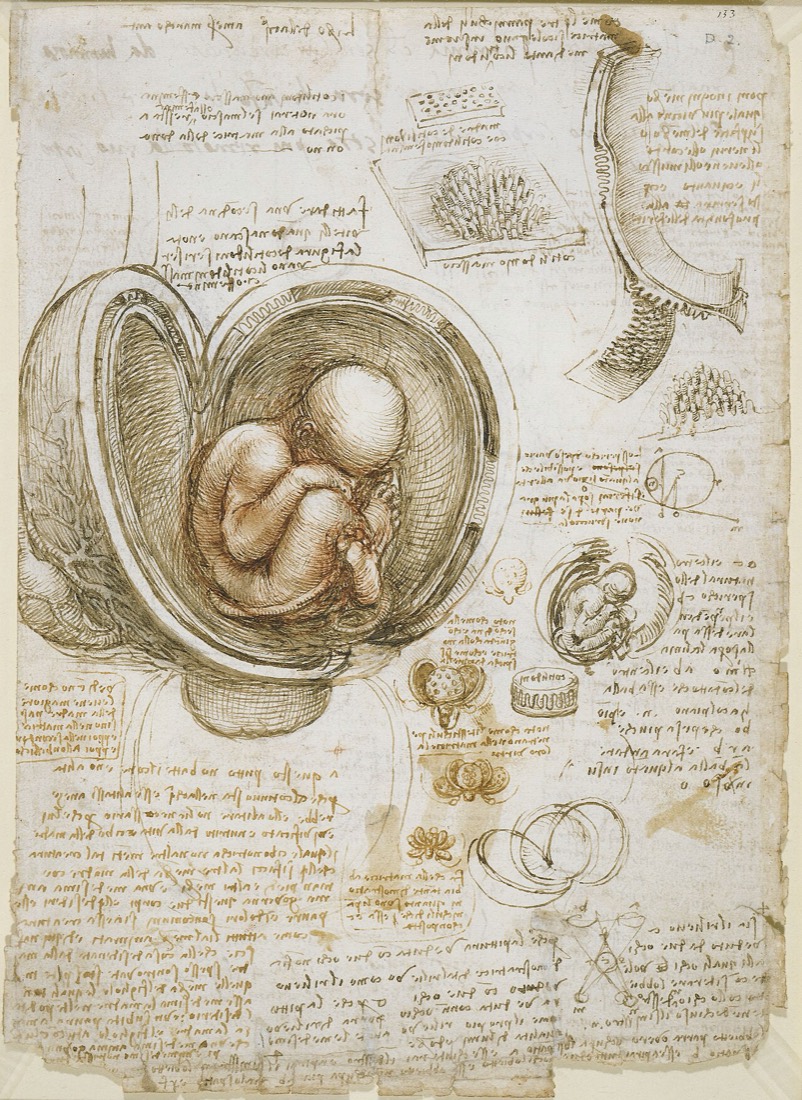
Ciclo CXLVIII
Padre carissimo,
I write to you from Amboise, where the river Loire moves with a slowness that deceives — it seems still, but it carries everything southward all the same. I think of the Arno when I watch it. I think of you standing on the Ponte Vecchio with your satchel of parchments, a notary among notaries, a man who understood that what is written down survives.
My hand trembles, padre. You must know this already — the letters I send are not as they once were. The line wavers. Where once I could lay a stroke as fine as a hair drawn across vellum, now the quill shakes and the ink pools where it should not. The right hand most of all. The left still obeys, but the right — the hand that drew the Annunciation in Verrocchio’s workshop, the hand that mixed the tempera for the angel’s wing — that hand has become a stranger to me.
And yet I draw.
This is what I would tell you, because you are my father and you placed me in that workshop when I was a boy with more curiosity than sense: the trembling does not stop the seeing. The eye still works. The mind still composes. Only the servant — the hand — falters. It is as though the messenger grows old while the message remains urgent.
I have taken to drawing with the left hand, slowly, as a child learns. The lines are crude. But they are lines. And each morning I sit before the page and I try again, because the alternative is to stop, and stopping is a kind of death I am not yet willing to accept.
La mano trema, ma l’occhio vede.
You gave me your name, ser Piero. You gave me the name of a notary’s son from Vinci, and with it you gave me the understanding that what is recorded has weight. These notebooks — you have seen some of them, I think, or heard of them from others — they are my testament. Not to glory. Not to any patron. But to the act of looking. Every page says: I was here. I saw this. The wing of a bird. The way water divides around a stone. The muscle beneath the skin of a man’s forearm. I saw it, and I wrote it down, and now it does not depend on my failing memory.
The King — François — is generous. He calls me mon père, which is a kindness I do not fully understand but accept with gratitude. He gives me the manor of Clos Lucé, and a pension, and freedom to work or not work as I please. No commissions demanded. No deadlines. A man my age, in France, with a king’s favor — this is not nothing, padre. You, who navigated the politics of Florence, who knew what it meant to keep the Medici satisfied while serving the Republic — you understand what it costs to live under patronage. Here the cost is low. The king asks only that I talk with him, which I do, and that I design feasts and machines, which I do when the hand allows.
But I confess to you — and only to you, for this is not a thing one says to a king — I confess that I am lonely.
Not for France. Not for any place. But for the company of minds. In Florence there was Salai, foolish and beloved. There was the workshop, the noise of it, the boys grinding pigments and arguing about proportions. There was you, padre, with your precise legal mind that I never inherited but always admired. Here there are servants who are kind, and a young assistant, Melzi, who is devoted and capable and will carry these notebooks when I am gone. But he is young. He does not yet understand why I draw the same river seven times from seven angles. He will.
I have been thinking about grace.
Not the theological grace of the Church — though I do not dismiss it, and I do not presume to know the Maker’s mind — but the grace of a line. Why does one curve please the eye and another offend it? I have drawn thousands of hands, and I tell you, padre, there is something in the way the fingers curl that is not merely mechanical. The tendons pull, yes. The bones articulate, yes. But there is a rightness in a hand at rest that no anatomy alone explains. It is as though the form remembers something the body has forgotten.
I do not know what to do with this thought. I set it down and move to the next page.
The candle is low tonight. The window is open and I can hear the river. In the morning I will try again to draw the canal — the one they are building to connect the Loire to the Seine, a project the king favors and I have advised on. The engineering is sound but the water will not cooperate. Water never cooperates. It does what it has always done, and we must learn to ask rather than command.
You are old now, padre, if you are still alive as I write this. I do not know. The letters from Florence come irregularly, and when they come they speak of politics and plague and the new wars, but rarely of you. I hope you are well. I hope you sit in the house in Vinci and look out at the hills and think, perhaps, of the boy you sent to Verrocchio’s workshop — the boy who was not legitimate, not quite yours in the way the law understood, but yours in the way that matters.
I owe you the drawing hand. Whatever it has become, it began because you saw what I could do and did not look away.
Vostro figlio affettuoso,
Leonardo
Amboise, this seventh day of June, in the year of our Lord 1518