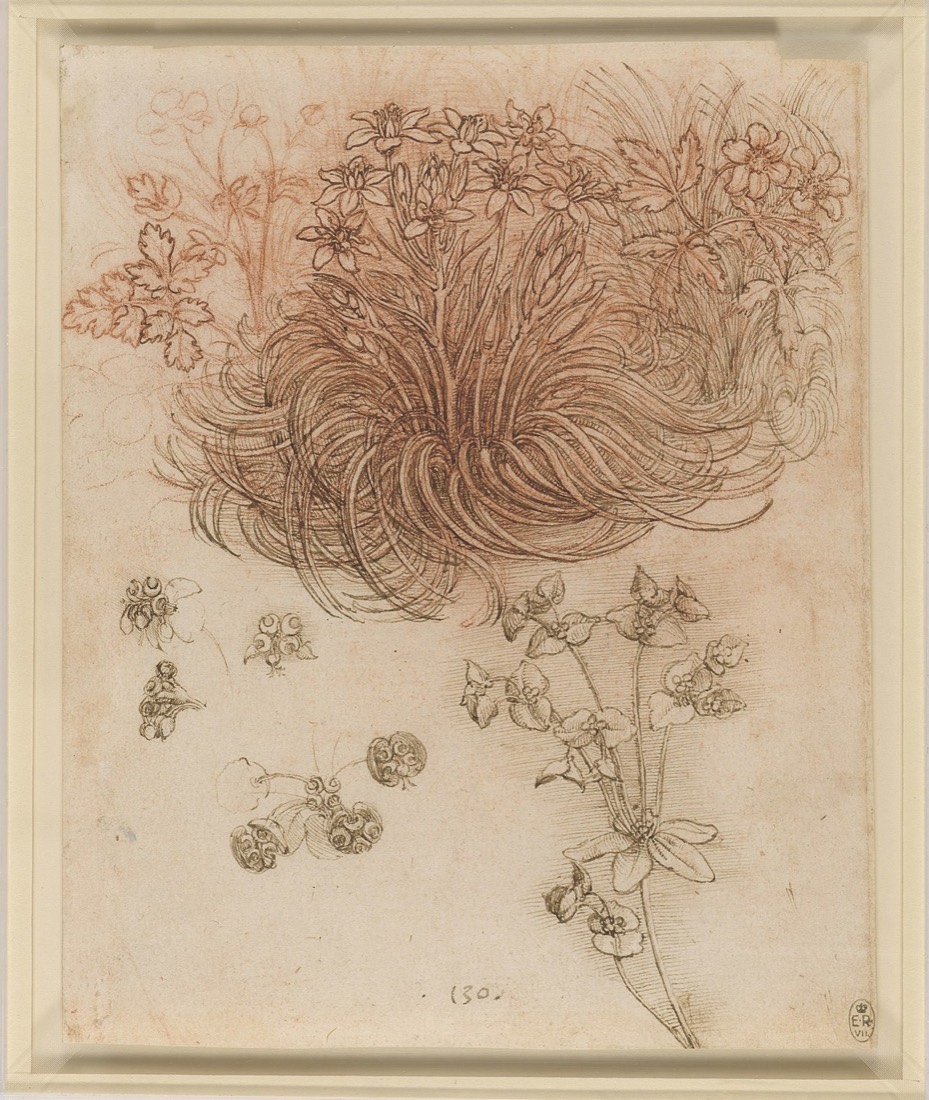
Folio d5ab89ee
Italiano
Tre segni mi dicono che la pianta non è un oggetto passivo che attende la forma dal cielo, ma una macchina che si corregge, che si ripiega su sé stessa come un maestro che corregge il gesto dello scolaro.
Il primo segno è scritto in un appunto che trema: «Me» mi risolvo finalmente nell’animo di trovare >1 modo che ella si volterebbe senza tante difese, senza restare impigliata nelle sue stesse spine. È lo sforzo dell’animo di trovare più di una via per piegarsi, per voltarsi senza rompersi, senza restare prigioniero del proprio peso.
Il secondo segno: huomo veramente ingegnolo, sofistico — la natura è ingegnosa come quell’uomo che costruisce specchi per vedere meglio, e questa ingegnosità è sofistica, perché sa ingannare per condurre a un fine, perché sa deviare il sole per non bruciarsi, piegare il ramo per non spezzarsi.
Il terzo segno: The subject well deserves to be discussed at great length, but I will here take only a single case — ogni caso è un nodo di una trama più vasta, e una foglia, un solo caso, può svelare la legge della spirale. Dunque la pianta si muove in una geometria di errori corretti, di vie secondarie che diventano principali, di foglie che si avvolgono su sé stesse per sfuggire alla violenza del sole o per afferrare l’aria.
Essa è una bottega in cui ogni foglia è un apprendista che impara a voltarsi, a piegarsi, a trovare il modo senza restare prigioniera delle sue stesse difese. Il mattino è ancora buio. La candela si spegne.
English
Three signs tell me the plant is not a passive object awaiting form from heaven, but a machine that corrects itself, folds back upon itself like a master correcting the pupil’s gesture.
The first sign is written in a trembling note: ‘Me’ I resolve at last in the soul to find >1 way that it would turn without so many defenses, without becoming entangled in its own thorns. It is the soul’s effort to discover more than one path to bend, to turn without breaking, without remaining prisoner of its own weight.
The second sign: a man truly ingenious, sophistic — nature is as ingenious as that man who builds mirrors to see better, and this ingenuity is sophistic because it knows how to deceive in order to reach an end, how to divert the sun so as not to burn, how to bend the branch so as not to break.
The third sign: The subject well deserves to be discussed at great length, but I will here take only a single case — every case is a knot in a larger weave, and a leaf, one case, can reveal the law of the spiral. Thus the plant moves in a geometry of corrected errors, of secondary paths that become main, of leaves that coil upon themselves to escape the violence of the sun or to grasp the air.
It is a workshop where every leaf is an apprentice learning to turn, to bend, to find the way without remaining trapped in its own defenses. The morning is still dark. The candle gutters out.