Folio b5e325a3
Italiano
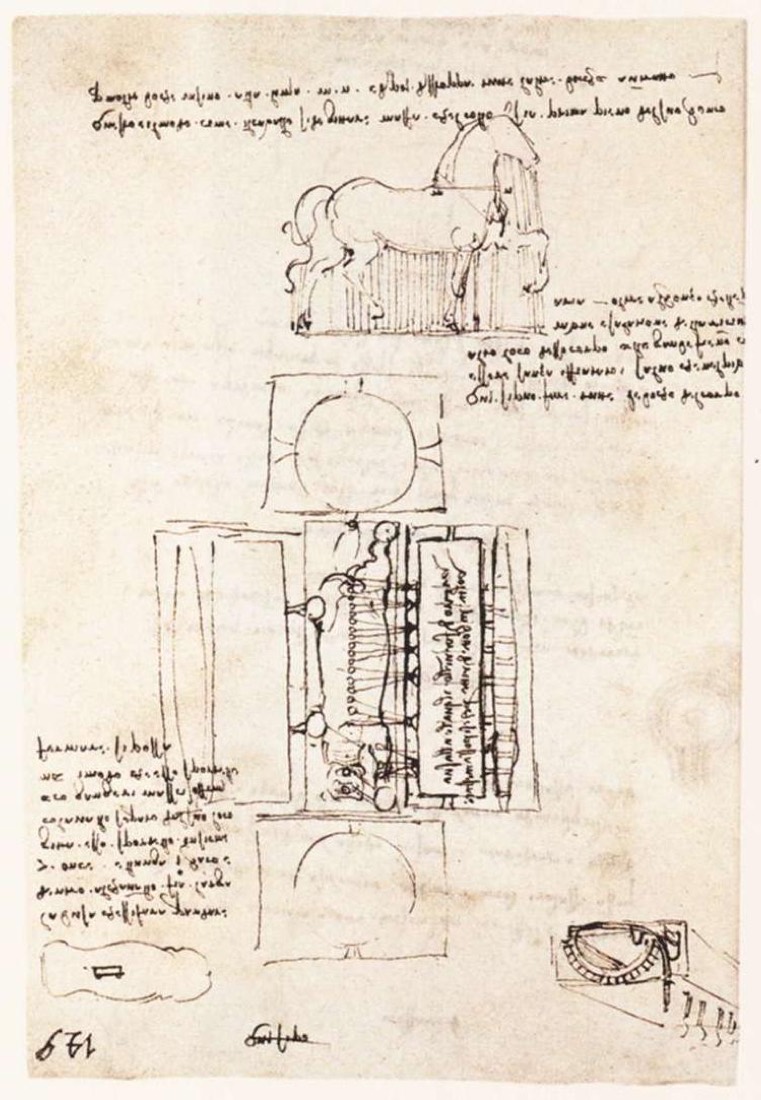
Tre frammenti — uno scribacchiato sopra il torso che si sfa nella nebbia di Cluny, uno che mormora d’una forma che si muta nell’altra senza peso che si perda o si guadagni, e un terzo che richiama altre tavole disperse — mi dicono che il corpo non è un oggetto, ma un luogo di passaggio. Ogni osso, ogni muscolo, ogni umore è un punto di transito dove materia ed energia si scambiano senza mai fermarsi. La carne è il disegno che si cancella mentre la mano lo traccia; l’anatomia, la mappa di questi passaggi. Non è la carne che cerco, ma il moto che la muove. Intorno al 1480, quando la mano ancora obbediva agli ordini del bottega e non ancora tremava come ora, iniziai a sezionare non solo il corpo ma il tempo stesso che lo attraversa. Forse ogni figura che disegno non è che la traccia d’un movimento che continua oltre il foglio, oltre la vita. La mano trema perché sente che il corpo si dissolve mentre lo afferra, eppure scrive. Tre voci di un’unica domanda: se l’acqua, quella che spinge il pesce controcorrente, che dissolve il sale nei laghi remoti, che porta il pittore a inseguire riflessi, non sia anche medicina per chi è sballottato tra cielo e abisso. La freschezza dell’acqua dolce che si diffonde senza forma è come l’assenzio che calma lo stomaco agitato: entrambe parlano di un equilibrio che la mano dell’uomo cerca di afferrare, sia con la pompa che con il pennello. Forse, in fondo, l’acqua è il medium che unisce ciò che si muove nel corpo a ciò che si muove fuori di esso.
English
Three fragments — one scrawled over the torso dissolving into the mist of Cluny, one murmuring of a form that shifts into another without weight gained or lost, and a third recalling other scattered sheets — tell me that the body is not an object, but a place of passage. Every bone, every muscle, every humor is a transit point where matter and energy exchange without ever stopping. The flesh is the drawing that erases itself as the hand traces it; anatomy, the map of these passages. It is not the flesh I seek, but the motion that moves it. Around the year 1480, when the hand still obeyed the workshop’s orders and did not yet tremble as it does now, I began to dissect not only the body but the time that passes through it. Perhaps every figure I draw is only the trace of a movement that continues beyond the page, beyond life. The hand trembles because it feels the body dissolve even as it grasps it, and yet it writes. Three voices of a single question: whether the water — that which pushes the fish upstream, dissolves salt in remote lakes, drives the painter to chase reflections — is not also medicine for one tossed between sky and abyss. The coolness of fresh water spreading without form is like wormwood calming an unsettled stomach: both speak of a balance the human hand seeks to grasp, with pump or brush alike. Perhaps, in the end, water is the medium that unites what moves within the body to what moves outside it.