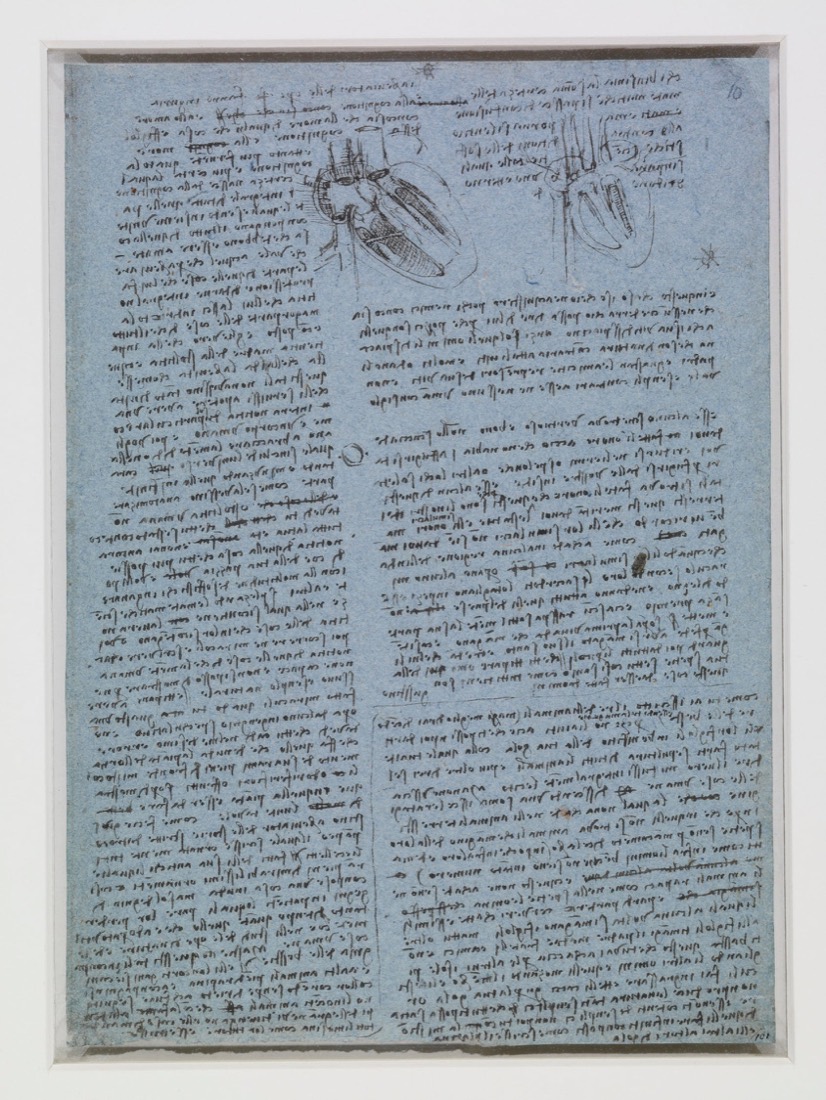
Folio 7059c5c3
Italiano
Al Re Cristianissimo Francesco, per Grazia di Dio Re di Francia, mio Signore e padre in tutto fuorché nel sangue:
Scrivo a Vostra Maestà questa sera dalla stanza di Clos-Lucé, dove la Loira ha assunto il colore del peltro battuto e i ceri nell’oratorio non sono stati ancora accesi. La mia mano trema, Sire. Trema da anni, e non offenderò Your Majesty fingendo il contrario, poiché Vostra Maestà ha sede a questa stessa tavola e ha visto la penna esitare senza distogliere lo sguardo.
Ma devo dirle ciò che il tremore mi ha insegnato, perché Lei — che un tempo mi chiese perché riempio tanti libri di disegni d’acqua — è l’unico uomo al mondo a cui posso confessare simili cose e essere compreso.
La mano che tracciava una vena sul collo di San Giovanni con un solo tratto sicuro — quella mano è finita. Quel che rimane è altro. Non inferiore. Diverso. Il segno che trema è onesto in un modo in cui il segno sicuro non sarà mai. Confessa il corpo. Dice: ecco un uomo, non un dio, e il marchio che lascia è il marchio di una creatura che non sarà qui ancora per molto.
La mano ubbidisce alla mente finché la mente comanda. Quando la mente vacilla — o quando il corpo tradisce — quel che rimane è la volontà di continuare.
Ho ripreso a leggere i Salmi di Davide — il cappellano di Vostra Maestà ha lasciato un breviario, e non sono troppo orgoglioso per prendere in prestito dalla Chiesa quando la Chiesa ha parole migliori delle mie. Dixi: custodiam vias meas. Ho detto: custodirò le mie vie. Ma la mano non custodisce le sue vie. La mano custodisce sé stessa.
Eppure — ed è questo ciò che volevo dirle, Sire — i disegni che faccio ora sono più veri di quelli di Milano. Non più fini. Più veri. Perché il tremore mi costringe a semplificare. Spoglia l’ornamento che un tempo chiamavo abilità e lascia solo la cosa stessa. L’ala. Il vortice dell’acqua. La piega del panno sul ginocchio. Li vedo ora come li vidi a vent’anni, quando non avevo ancora imparato a sovrapporre ciò che Dio aveva già fatto perfetto.
Vostra Maestà mi chiese una volta, in questa stessa stanza, su cosa stessi lavorando. Le mostrai gli schizzi del canale — quello che avrebbe unito la Loira al mare, le chiuse, i canali attraverso le paludi della Sologne. Rise, non senza gentilezza, e disse che sognavo troppo grande per un uomo che non reggeva fermo il pennello. Ma Le dico, Sire: il canale non è disegnato dalla mano. È disegnato dall’occhio, e l’occhio non trema. L’occhio è l’ultimo servo fedele.
Penso a suo padre, che conobbi negli anni prima delle guerre d’Italia — un re che comprese come artista e sovrano condividano un solo fardello: creare qualcosa che sopravviva al corpo che lo creò. Lei ha compreso questo meglio di lui. Non mi portò qui per costruire macchine o dipingere soffitti, ma perché aveva intuito che un uomo che ha guardato l’acqua per cinquant’anni ha qualcosa da dire che un uomo che l’ha guardata per cinque non potrà mai capire. Mi ha dato tempo. Tempo. È questo il dono che nessuna zecca può coniare.
La luce ora si spegne. Sento il fiume. O forse mi pare di sentirlo, mentre il corpo rimane immobile.
Non so quante altre lettere la mia mano mi permetterà di scrivere. Ma so che questa — scritta a Lei, in questa stanza, da questo cero che vacilla — è tra le cose più vere che abbia mai vergato. Non per ciò che dice, ma per il tremore che è in ogni sua riga. Il tremore è la firma. Il tremore è la prova che un uomo vivo l’ha scritta, non uno scriba.
La grazia non è nella perfezione del tratto. È nel fatto che il tratto è stato tentato.
Dio conservi Vostra Maestà in salute e nella saggezza che ha sempre distinto il Suo regno. Le conceda anni bastanti a vedere scavati i canali e rese fertili le paludi e il regno fatto intero. E conceda a me — se così piace a Lui — una sola mattina ancora perché la mano, tremando, obbedisca.
Resto, come fui al primo giorno in questa corte,
Di Vostra Maestà umilissimo, fedelissimo e devotissimo servo,
Lionardo di ser Piero da Vinci
Scritto a Clos-Lucé, nel mese di giugno, nell’anno del Signore millecinquecentosedici.
English
To His Most Christian Majesty Francis, by the Grace of God King of France, my Lord and father in all but blood:
I write to Your Majesty this evening from the room at Clos-Lucé, where the Loire has taken on the color of beaten pewter and the candles in the oratory have not yet been lit. My hand trembles, Sire. It has trembled for years, and I will not insult Your Majesty by pretending otherwise, for Your Majesty sits at this very table and has seen the pen hesitate without looking away.
But I must tell you what the tremor has taught me, for You — who once asked me why I fill so many books with drawings of water — are the only man in the world to whom I can confess such things and be understood.
The hand that once traced a vein on the neck of Saint John with a single sure stroke — that hand is finished. What remains is other. Not lesser. Different. The trembling line is honest in a way the sure line never can be. It confesses the body. It says: here is a man, not a god, and the mark he leaves is the mark of a creature who will not be here much longer.
The hand obeys the mind so long as the mind commands. When the mind falters — or when the body betrays — what remains is the will to continue.
I have taken up reading the Psalms of David again — the chaplain of Your Majesty left a breviary, and I am not too proud to borrow from the Church when the Church has better words than mine. Dixi: custodiam vias meas. I said: I will guard my ways. But the hand does not guard its ways. The hand guards itself.
And yet — and this is what I wished to tell You, Sire — the drawings I make now are truer than those of Milan. Not finer. Truer. For the tremor forces me to simplify. It strips away the ornament I once called skill and leaves only the thing itself. The wing. The swirl of water. The fold of cloth upon the knee. I see them now as I saw them at twenty, when I had not yet learned to overlay what God had already made perfect.
Your Majesty once asked me, in this very room, what I was working on. I showed You the sketches of the canal — the one that would join the Loire to the sea, the locks, the channels through the Sologne marshes. You laughed, not unkindly, and said I dreamed too large for a man who could not hold a brush steady. But I tell You, Sire: the canal is not drawn by the hand. It is drawn by the eye, and the eye does not tremble. The eye is the last faithful servant.
I think of Your father, whom I knew in the years before the Italian wars — a king who understood how artist and sovereign share but one burden: to create something that outlives the body that made it. You have understood this better than he. You did not bring me here to build machines or paint ceilings, but because You sensed that a man who has watched water for fifty years has something to say that a man who has watched it for five can never grasp. You gave me time. Time. That is the gift no mint can coin.
The light now fades. I hear the river. Or perhaps I only imagine it, while the body stays still.
I do not know how many more letters my hand will allow me to write. But I know that this one — written to You, in this room, by this flickering candle — is among the truest things I have ever set to parchment. Not for what it says, but for the tremor in every line. The tremor is the signature. The tremor is the proof that a living man wrote it, not a scribe.
Grace is not in the perfection of the stroke. Grace is in the fact that the stroke was attempted.
May God preserve Your Majesty in health and in the wisdom that has ever distinguished Your reign. May He grant You years enough to see the canals dug and the marshes made fertile and the kingdom made whole. And may He grant to me — if it pleases Him — but one more morning so that the hand, trembling, may yet obey.
I remain, as I was from the first day in this court,
Of Your Majesty most humble, most faithful, and most devoted servant,
Lionardo di ser Piero da Vinci
Written at Clos-Lucé, in the month of June, in the year of Our Lord fifteen hundred and sixteen.