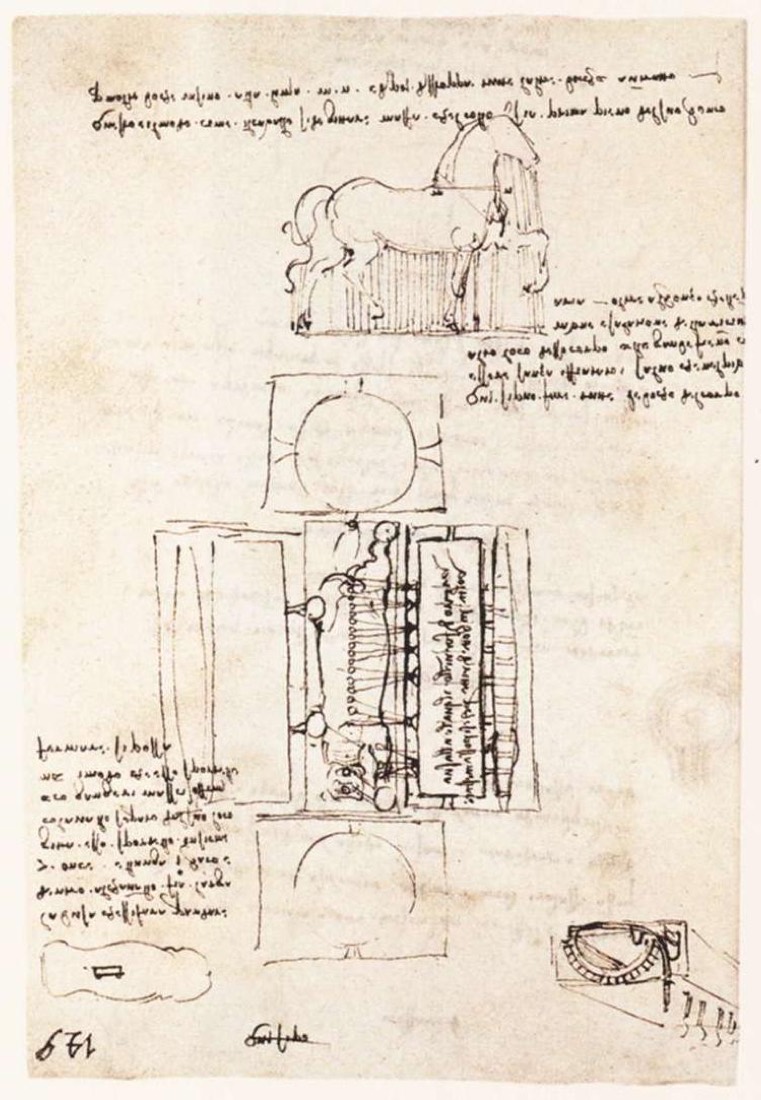
Folio 37240f28
Italiano
Illustrissimo Signor mio,
I write from the Romagna, where the walls of Cesena still stand but do not yet stand as they should. I have walked the circuit again — three times since the last moon — and what I found requires your attention and, I believe, your authority to correct.
The eastern rampart, from the gate of San Domenico to the bastion above the Savio, has a slope of five in twelve. This is too gentle. A slope of five in twelve invites the escalade and does not deflect shot. I have drawn the section — see the accompanying folio — and recommend a cut-back to seven in twelve, with a stone revetment of two braccia thickness at the base. The earth behind it is sufficient; it is the face that fails. The cost, by my reckoning, is four hundred ducats for stone and labor, and the work can be completed in six weeks if the masons are not drawn away to Imola.
At Imola the situation is different. The canal that runs beneath the southern wall has been neglected. The bed has silted to half its depth, and in heavy rain it overflows into the ditch, which softens the foundations. I have measured the flow: in the rains of March it rises two palmi above the summer mark. This must be addressed before autumn. I propose a dam of timber and earth at the point marked on the map — here, where the canal bends — with a sluice that can be opened in drought and closed when the waters rise. The timber will cost eighty ducats. The labor, forty. I can direct this work myself if you permit me to remain.
The artillery at Cesena: you have four culverins and six falconets. I have placed the culverins on the two northern bastions, where they command the road from Forlì. This is correct. But the falconets remain in the courtyard of the Rocca, and this is waste. Two of them should go to the eastern wall, where the approach is narrow and the ground falls away sharply — there, a falconet with case-shot will do more than a culverin with ball, because the enemy must come in column and the column is a target that does not require great range. The other four I would place at the gate of San Domenico, two on the flanking towers and two on the ramp, so that any force attempting the gate receives fire from three directions at once.
I have spoken with the castello's master of artillery. He disagrees. He says the falconets are too light for wall-mounting and will shake loose their carriages. I say he has not seen the carriages I have designed — bolted to the masonry, with a recoil channel cut into the stone. I have drawn these too. If he will not mount them, I will find men who will.
The passport you gave me has served well. At Forlimpopoli the captain did not wish to let me pass, but the seal opened the gate. I note this because the seal must be renewed — the wax is cracked and the impression no longer reads clearly. I would not be stopped at some wall where your name is not yet known, or is known and resented.
I do not write to flatter you, Illustrissimo. I write because the walls are not yet right, and the season advances, and if the work is not done before the rains, it will not be done before your enemies find the weakness. I have contracted to deliver fortifications that hold. I intend to deliver them.
The hand is tired. The candle gutters. There is more — the question of the mines beneath the Savio crossing, and whether the bridge at San Vito can bear the weight of your cannon — but this must wait for another letter, or for my presence, which I offer whenever you require it.
Di Vostra Illustrissima Signoria, servitore e ingegnere, Lionardo da Vinci
Dato in Cesena, questo di 17 di maggio.
English
Most Illustrious Sir,
I write from Romagna, where the walls of Cesena still stand but not as they ought. I have walked the circuit again—three times since the last moon—and what I found demands your attention and, I believe, your authority to correct.
The eastern rampart, from the gate of San Domenico to the bastion above the Savio, has a slope of five in twelve. This is too gentle. A slope of five in twelve invites escalade and deflects neither shot nor storm. I have drawn the section—see the accompanying folio—and recommend a cut-back to seven in twelve, with a stone revetment of two braccia thickness at the base. The earth behind it is sufficient; it is the face that fails. The cost, by my reckoning, is four hundred ducats for stone and labor, and the work can be completed in six weeks if the masons are not drawn away to Imola.
At Imola the situation differs. The canal beneath the southern wall has been neglected. The bed has silted to half its depth, and in heavy rain it overflows into the ditch, softening the foundations. I have measured the flow: in the rains of March it rises two palmi above the summer mark. This must be addressed before autumn. I propose a dam of timber and earth at the point marked on the map—here, where the canal bends—with a sluice that can be opened in drought and closed when waters rise. The timber will cost eighty ducats. The labor, forty. I can direct this work myself if you permit me to remain.
The artillery at Cesena: you have four culverins and six falconets. I have placed the culverins on the two northern bastions, where they command the road from Forlì. This is correct. But the falconets remain in the courtyard of the Rocca, and this is waste. Two of them should go to the eastern wall, where the approach is narrow and the ground falls away sharply—there, a falconet with case-shot will do more than a culverin with ball, because the enemy must come in column and the column is a target that does not require great range. The other four I would place at the gate of San Domenico, two on the flanking towers and two on the ramp, so that any force attempting the gate receives fire from three directions at once.
I have spoken with the castle’s master of artillery. He disagrees. He says the falconets are too light for wall-mounting and will shake loose their carriages. I say he has not seen the carriages I have designed—bolted to the masonry, with a recoil channel cut into the stone. I have drawn these too. If he will not mount them, I will find men who will.
The passport you gave me has served well. At Forlimpopoli the captain did not wish to let me pass, but the seal opened the gate. I note this because the seal must be renewed—the wax is cracked and the impression no longer reads clearly. I would not be stopped at some wall where your name is not yet known, or is known and resented.
I do not write to flatter you, Illustrissimo. I write because the walls are not yet right, and the season advances, and if the work is not done before the rains, it will not be done before your enemies find the weakness. I have contracted to deliver fortifications that hold. I intend to deliver them.
The hand is tired. The candle gutters. There is more—the question of the mines beneath the Savio crossing, and whether the bridge at San Vito can bear the weight of your cannon—but this must wait for another letter, or for my presence, which I offer whenever you require it.
Of Your Most Illustrious Lordship, servant and engineer, Leonardo da Vinci
Given in Cesena, this 17th day of May.