Ciclo CLXX
Padre carissimo,
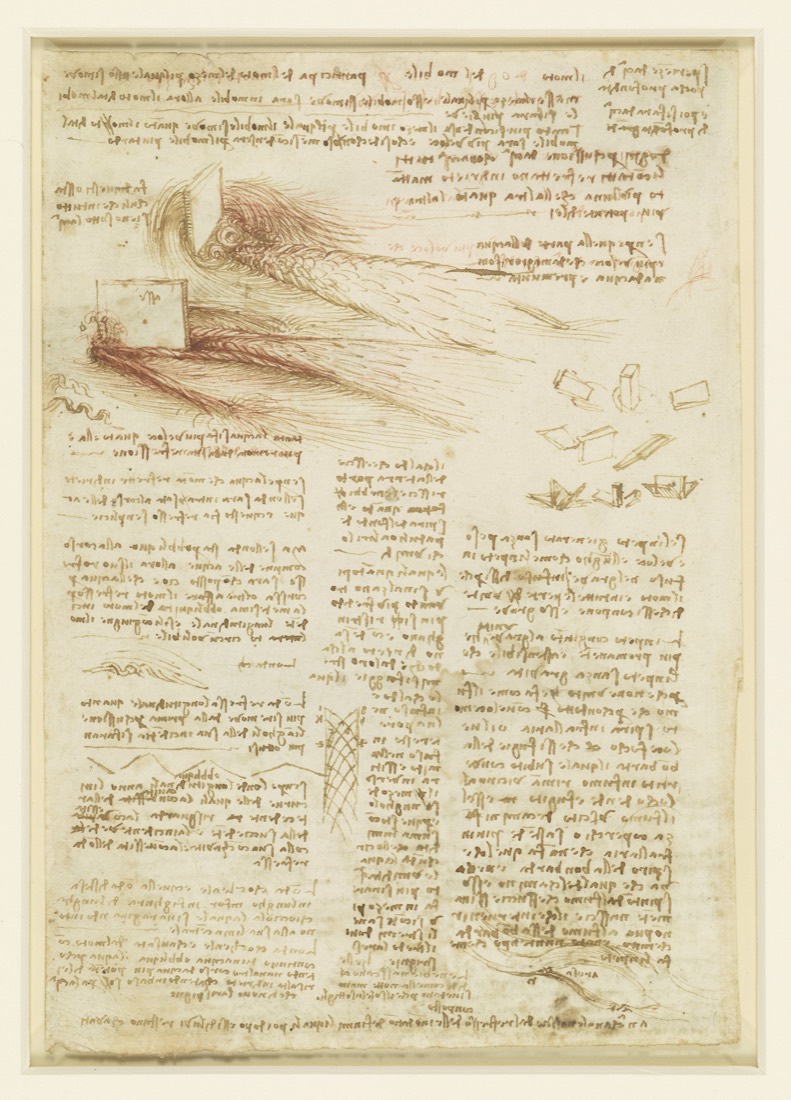
I write to you from Amboise, where the Loire is grey this morning and the château smells of wet stone and old rushes. My hand trembles more than it did when last I wrote — you will see it in the letters themselves, how they lean and correct themselves mid-stroke, as though the fingers argue with the will. Yet I draw still. I draw because the hand trembles. There is a truth in the wavering line that the steady hand cannot reach: it confesses the body, the years, the maker’s patience with what decays.
I have been at the canal again — the one they are digging near the new gardens, meant to carry water from the river to the king’s fountains. The engineers brought me to look at their plans, which are competent enough but lack misura. I showed them how the current will behave at the bend where the channel narrows, how the water does not turn as a cart turns, it pushes, it remembers its own weight. They listened. Whether they understood, I cannot say. The young men are polite but they want answers, not questions, and I have only questions left.
La mano trema, ma l’occhio vede. That is what I told myself this morning, standing at the window while the light came in pale and uncertain. The eye sees. The hand follows as it can. Between seeing and following there is a gap — and in that gap is where the work lives. I think of you, padre, when I say this. You saw what I could draw before I knew it myself. You brought me to Verrocchio not because you understood painting but because you understood that a gift ungiven is a sin against the one who gave it. Grazie. I have never said it plainly. I say it now.
The king is well. He asks after my health with genuine concern, which is more than most sovereigns offer. He does not ask after the work, which is also more than most sovereigns offer. There is a kindness in his indifference to completion. He lets me think. He lets me sit. A man of sixty-four, in France, permitted to think — this is not nothing.
I have been reading again the notes I made in Florence, thirty years past, on the movement of birds. Il volo. I was so certain then. The wing was a lever, the air a medium, the problem mechanical. Now I see it differently. The bird does not fly against the air. The air lifts because the bird asks it to. There is a conversation between the living thing and the element, and I did not hear it then. I hear it now because I am closer to not-hearing everything.
I do not know how long the hand will hold. The physicians here are gentle and useless, as physicians are. They speak of humors. I speak of nothing. The page receives what the body releases, and I release what I can.
Tell me, padre — do you remember the courtyard in Vinci, the way the light fell on the wall in the late afternoon? I see it more clearly now than I see this room. Memory is the truest drawing. It does not tremble.
Vostro figlio affettuoso, Leonardo
Amboise, this day in June, in the year of grace 1518.