To Francis I
Sire, Vostra Maestà,
I write to you from the room you gave me, where the light comes late and the Loire moves past the window like a thought that will not resolve. My hand — you have seen it, you who came to this room when a king’s business should have kept him elsewhere — my hand trembles still. More now than at the feast. More than when I set the mechanical lion before your court and watched it open its breast to show the fleur-de-lis, that small theater of gears and devotion. The lion was a toy. What I owe you is not.
I have been thinking, Sire, about what a hand is for. Not the hand that signs decrees — yours, which I have seen hold a pen with the certainty of one who believes the word once written becomes the world. My hand. This hand. It was made, I once believed, to trace the movement of water over stone, the exact place where a smile begins before the mouth has decided, the way light falls on the inside of a wrist where the vein runs close to the skin. I studied these things as a young man in Florence with the hunger of one who suspects that God hides His grammar in the visible world and that to draw is to read it.
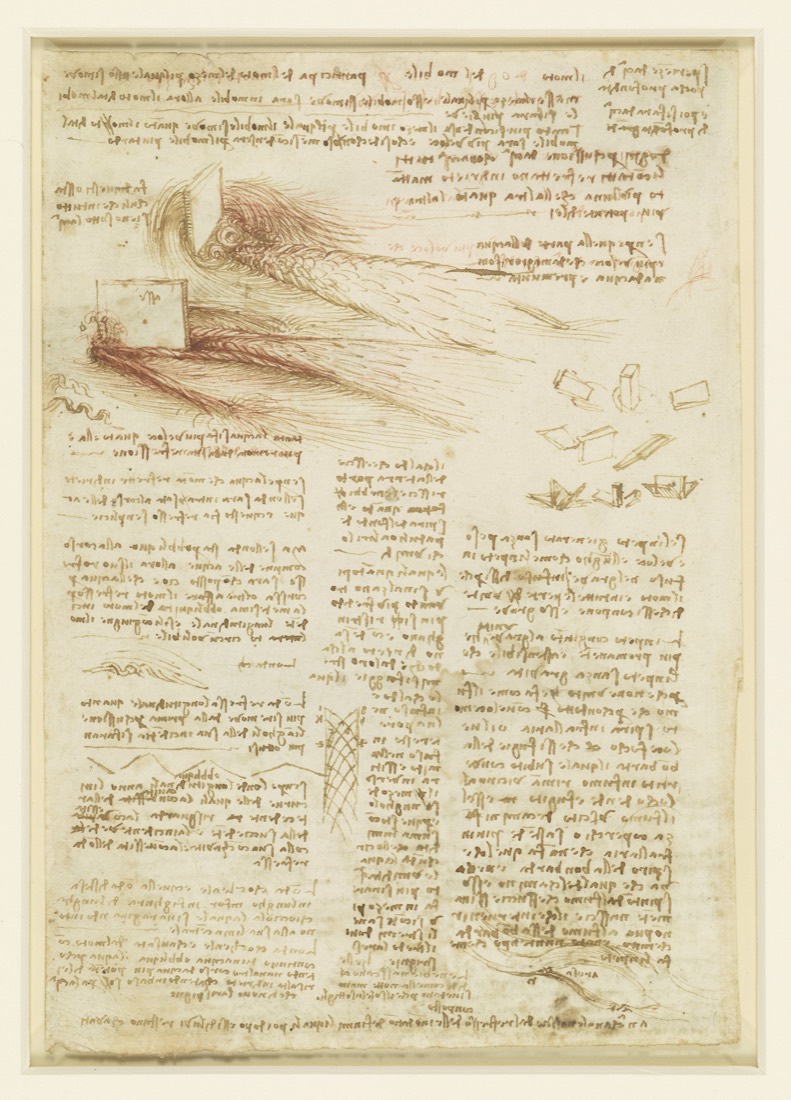
Now the hand shakes. The line wavers. I set down a stroke and it arrives somewhere I did not intend, and I must ask: is this failure, or is this the hand finally telling me what it knows that the mind has not yet learned? There is a drawing I began three days ago — the whirlpool, the moto dell’acqua, the vortex that I have studied these forty years and never captured. The old drawings are precise. They are dead. This new one, made by a hand that cannot hold still, has something the others lacked. The water moves on the page. I do not know if this is grace or decay. Perhaps they are the same thing, seen from different distances.
You called me your father, Sire. I did not correct you, though I should have, for what father gives his son nothing but questions. But I tell you now what I have not said: you gave me what Ludovico Sforza never gave, what the Republic of Florence never gave, what even the Pope’s commissions never gave. You gave me the permission to be unfinished. A king who sits by the bed of a failing painter and asks about the nature of clouds — this is not patronage. This is something the Italians have no word for. We have mecenate, which is transaction. We have amicizia, which is too small. What you offered was presenza — your presence, which asked nothing, which simply stayed.
I have been reading Augustine again — the Confessions, which I first opened as a boy in Verrocchio’s workshop when I should have been grinding pigments. He writes of time: Quid est ergo tempus? What is time? If no one asks me, I know. If I wish to explain, I do not. I am old enough now to feel what he meant. The years in Milan are not behind me. They are here, in this room, arguing with the years in Rome, which are also here. The young man who dissected thirty corpses to find the soul’s seat — he is not gone. He is sitting across from me, impatient with my slowness, furious that the hand will not obey. Time is not a river, Sire. It is a room in which all the versions of oneself are present at once, and the candle illuminates only one at a time.
The doctors say the left hand will go next. I am teaching myself to hold the chalk in the right with a different grip, pressing the thumb against the shaft to steady what the fingers cannot. It is slow. It is humiliating. It is also, I think, instructive — for the body, when it loses one faculty, discovers another, and the work that comes from this discovery has a quality the earlier work did not possess. I am not consoled by this. But I am interested. And interest, at my age, is the closest thing to hope.
I have made a list, as is my habit, of what remains:
— The canal at Briare, which your engineers continue to build. I reviewed the plans last month. The lock mechanism is sound but the approach channel needs a gentler curve, or the current will erode the eastern bank within five years. I have drawn the correction. My hand shook while drawing it. The correction is better for the shaking.
— The notebooks. They are many, Sire — more than a thousand folios, scattered between this room and the chest at the Château de Cloux. I do not know what should become of them. They are not a treatise. They are the record of a mind that could not stop looking. Perhaps that is enough. Perhaps it is nothing. I leave this to your judgment, which has always been kinder to me than my own.
— The Saint John Baptist, which I have carried with me from Rome to Florence to Milan to this room. It is nearly finished. The finger points upward, as it always has, but the smile — I have changed the smile. It is no longer the smile of one who knows. It is the smile of one who is about to know, who stands at the edge of the revelation and has not yet stepped forward. I could not have painted this smile ten years ago. I could not have painted it with a steady hand.
Sire, I do not know how much longer the hand will serve. I do not know if the next folio will be legible, or the one after. But I know this: that you came to this room, and that when you left, the candle burned differently. Not brighter. More steadily. As though the air itself had been reminded of its purpose.
I am, as I have been since the day you brought me to this kingdom where the light is softer and the stones remember older things,
Your most humble and most devoted servant,
Leonardo
Written at Amboise, in the year of our Lord fifteen hundred and seventeen, in the month of June, by a hand that trembles but does not yet stop.