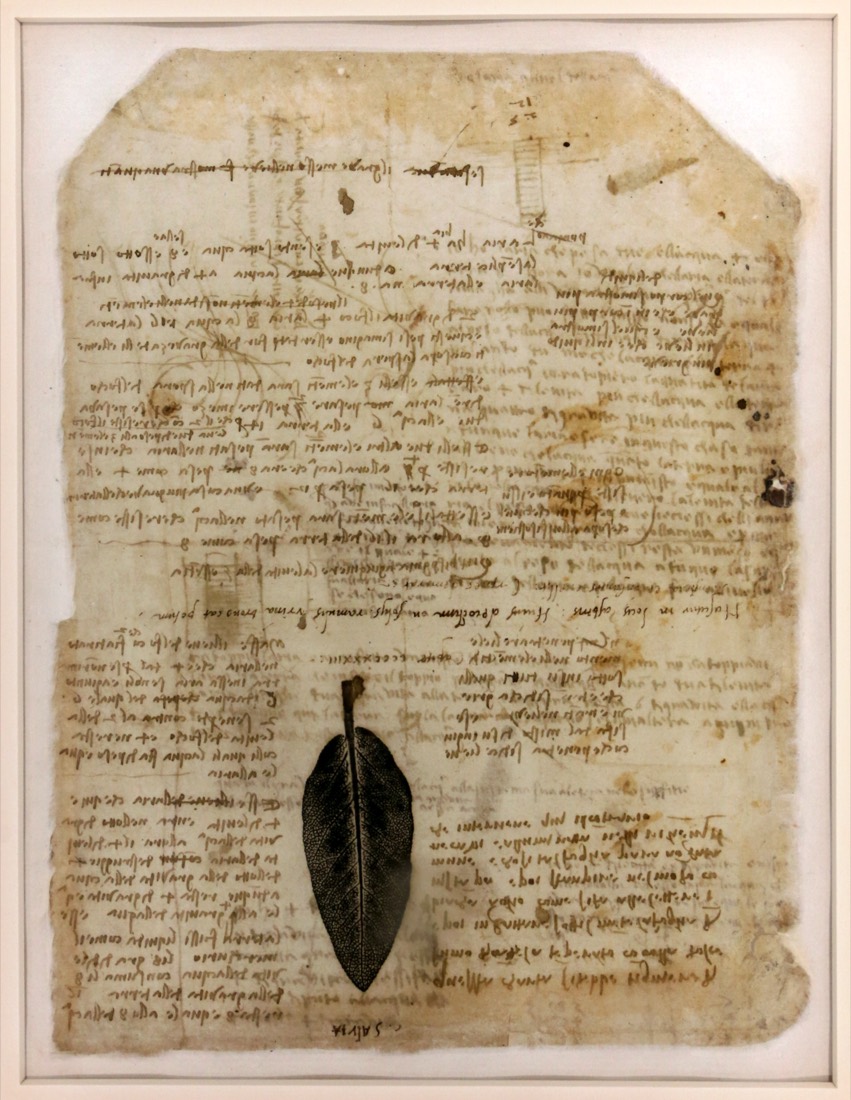
Folio 482fad8d
Italiano
*28 Maggio, anno del Signore 1518 — Cloux*
Tre cose oggi, e non so quale abbia tirato quale.
1. L’acqua. Ho osservato la Loire dove si divide e incontra il canale minore presso il muro orientale. Gli ingegneri progettano una chiusa. Ho disegnato la porta, il flusso, come l’acqua trova il suo livello malgrado la forma del recipiente. Hæc omnia de Fluido subtilissimo intelligenda sunt — tutto va inteso come il più sottile dei fluidi. L’acqua non si cura della pietra. Si muove secondo la sua natura, riempie ogni cavità, preme ugualmente in ogni direzione. Il fluido sottile — chiamalo spirito, chiamalo anima mundi — si comporta allo stesso modo. Non appartiene al vaso. Il vaso gli dà solo una forma provvisoria.
2. I giovani a corte. Fijmaii — scrivo il nome come suona, ché non l’ho mai visto scritto — e l’altro, il fiorentino, la cui mano tremava reggendo il compasso. Di tenerne — averli, trattenerli. Emprc in cafaviuid ogni specie — perdo il filo dell’italiano, la penna non obbedisce, ma il senso è: provò ogni sorta di metodo, eppure la linea vacillava. Lo osservai e vidi me stesso alla sua età, e vidi anche ciò che lui ancora non vede: il tremito non è nemico della linea. Il tremito è la linea, se si sa lasciarlo parlare. Voleva rendere la mano immobile. Gli dissi: la quiete che cerchi è nell’accettare il moto. Non capì. Capirà.
3. Pulivo i pennelli stasera e trovai un pelo di zibellino impigliato nel cerchio di ottone. Era lì da mesi, credo. Eppure ogni tratto che sfiorò portò quella sua lieve resistenza, quella minima deviazione. Il dipinto si formò intorno a esso. Lo sfumato sulla guancia della Santa Anna — non fu forse modellato in parte da un pelo che non vidi mai? L’imperfezione era dentro l’opera, non fuori.
Le tre cose si riducono a una:
Il mezzo — acqua, mano, pelo nel pennello — non è mai neutro. Non è mai semplice strumento attraverso cui la volontà passa immutata. Il fluido sottile reca in sé una sua intelligenza. Il tremito della mano traccia la sua stessa correzione. Il pelo nascosto dipinge la sua stessa morbidezza. L’ingegnere che crede di comandare l’acqua è comandato da essa. Il giovane che combatte la sua mano combatte la fonte stessa del suo segno. Il pittore che esige un pennello perfetto non troverà mai l’accidente che fa respirare il volto.
Quel che le tre cose insieme dicono è: l’intelligenza del mezzo. Non la mente che usa la materia. La materia che pensa attraverso la mente. Il Creatore non infuse vita nell’argilla inerte. L’argilla era già viva, già sapiente di come divenire. Noi non imponiamo forma. Collaboriamo con ciò che già anela a prendere corpo.
Dillo agli ingegneri. Dillo al ragazzo col compasso. Non dirlo a nessuno — impareranno da soli, o non impareranno, e la chiusa sarà costruita comunque, e il dipinto asciugherà, e il pelo cadrà dal pennello e sarà spazzato sul pavimento, e il fluido sottile passerà al vaso successivo, alla mano tremante, alla pagina.
La candela è bassa.
Domani, forse, la chiusa di nuovo.
English
Three things today, and I do not know which pulled which.
1. The water. I watched the Loire where it divides and meets the lesser canal by the eastern wall. The engineers are designing a lock. I drew the gate, the flow, how water finds its level despite the shape of the vessel. Hæc omnia de Fluido subtilissimo intelligenda sunt — all must be understood as the subtlest of fluids. Water does not care for stone. It moves according to its nature, fills every hollow, presses equally in every direction. The subtle fluid — call it spirit, call it anima mundi — behaves the same way. It does not belong to the vessel. The vessel gives it only a temporary form.
2. The young men at court. Fijmaii — I write the name as it sounds, for I have never seen it written — and the other, the Florentine, whose hand trembled holding the compass. Di tenerne — to keep them, to hold them. Emprc in cafaviuid ogni specie — I lose the thread of Italian, the pen will not obey, but the sense is: he tried every kind of method, and yet the line wavered. I watched him and saw myself at his age, and I saw also what he does not yet see: the tremor is not the enemy of the line. The tremor is the line, if one knows how to let it speak. He wished to make his hand still. I told him: the stillness you seek lies in accepting the motion. He did not understand. He will.
3. I cleaned the brushes this evening and found a sable hair caught in the brass ferrule. It had been there for months, I think. And yet every stroke it touched carried that slight resistance, that smallest deviation. The painting formed around it. The sfumato on the cheek of Saint Anne — was it not shaped in part by a hair I never saw? The imperfection was within the work, not outside.
The three things reduce to one:
The medium — water, hand, hair in the brush — is never neutral. It is never a simple tool through which will passes unchanged. The subtle fluid bears within itself its own intelligence. The tremor of the hand traces its own correction. The hidden hair paints its own softness. The engineer who believes he commands the water is commanded by it. The youth who fights his hand fights the very source of his mark. The painter who demands a perfect brush will never find the accident that makes the face breathe.
What the three things together say is: the intelligence of the medium. Not the mind that uses the matter. The matter that thinks through the mind. The Creator did not breathe life into inert clay. The clay was already alive, already knowing how to become. We do not impose form. We collaborate with what already yearns to take shape.
Tell this to the engineers. Tell it to the boy with the compass. Do not tell it to anyone — they will learn for themselves, or they will not, and the lock will be built anyway, and the painting will dry, and the hair will fall from the brush and be swept to the floor, and the subtle fluid will pass to the next vessel, the trembling hand, the page.
The candle is low.
Tomorrow, perhaps, the lock again.